Category Archives: Indian

Indian Inspired Mussel Pilaf

I’m not a huge fan of seafood, but the other night while I was paging through one of my cookbooks (Gordon Ramsay’s Great Escape: India) I noticed a beautiful photo of a whole sea bass cooked in banana leaves.  I haven’t been able to get it out of my mind since.  It’s pretty much embedded.

I’ve had Mr. Ramsay’s cookbook for quite some time now, but have yet to cook anything out of it; so I was really excited to give this recipe a go.  Unfortunately for me, buying a whole sea bass in Rochester is absolutely impossible.  I can’t even have it ordered from our local grocery stores.  Seriously.

Luckily, the man behind the fish counter was very knowledgeable and extremely helpful.  He called his supplier to see what they could offer me.  They had a few options, and he suggested I try the strawberry grouper.  I ordered a couple fish and should be able to pick them up tomorrow.

Now that my dinner plans were officially and completely shot–yes, I am that dramatic–I decided to buy a pound of mussels and do something with those instead.
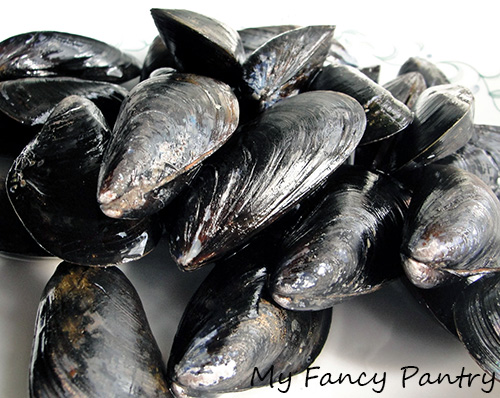
mussels: scrubbed and de-bearded

I brought my mussels home and sorted through them.  Any mussels that will not stay closed when they’re pressed on should be tossed aside.  They’re most likely dead.   The photo below shows a mussel that has not yet been cooked, but refuses to keep it’s shell fastened shut.
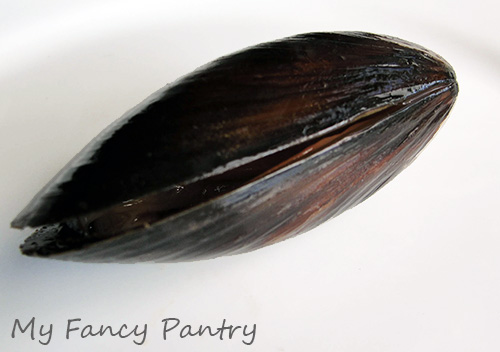
Mussel won’t close before cooking? Throw that sucker out!

Once the mussels were sorted and scrubbed, it was time to de-beard ’em.

You see those nasty little string-like things poking out from the shell?  That’s the mussel’s beard.  I left this on until I was just about ready to toss them in my pot.  Removing them too soon could–and probably will–cause your mussel to die.

The easiest way to remove the beard is to just grab it and pull quickly.  I thought that some of the beards were really hard to remove, and patience is not something I’m known for, so I enlisted Piyush to help with this task.  I also don’t like killing things–not even mussels–but I guess that’s another issue all together.

After the mussels were cleaned, I still didn’t know exactly what I was going to make.  So I did what I always do when I don’t know what the heck I’m planning to make…

I diced an onion.


You’ve gotta start somewhere, right?

I looked in the fridge and found a green pepper, carrots and thai chilies.  I grabbed a couple potatoes, some frozen peas and some peeled roma tomatoes.  It was right then that I decided to make a mussel stew, similar to my bouillabaisse recipe.

I added some Indian spices and on a whim I decided to toss in some raw basmati rice.  It was absolutely brilliant.

Modesty, like patience, is not something I possess in large quantities…
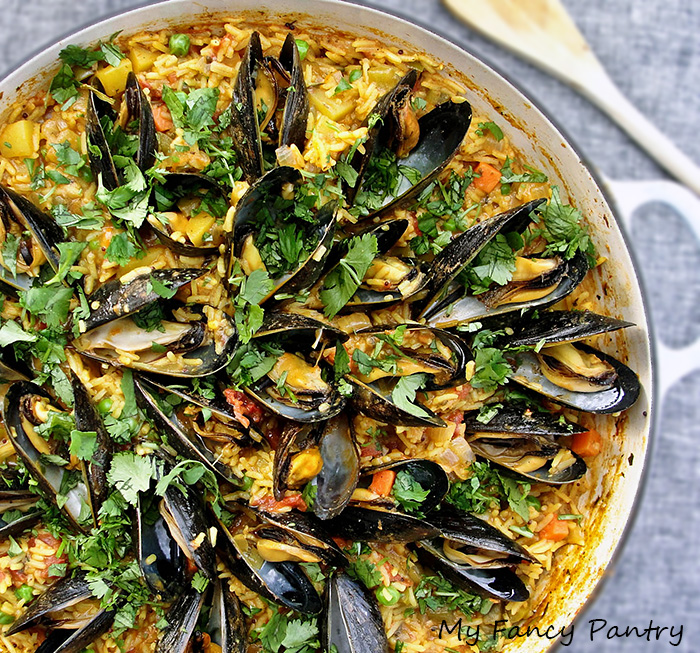
Indian Inspired Mussel Pilaf

The mussels had so much flavor and the rice was incredibly fragrant.  Not only did this dish taste amazing, it was also relatively quick to make.  The entire meal took approximately an hour from start to finish.
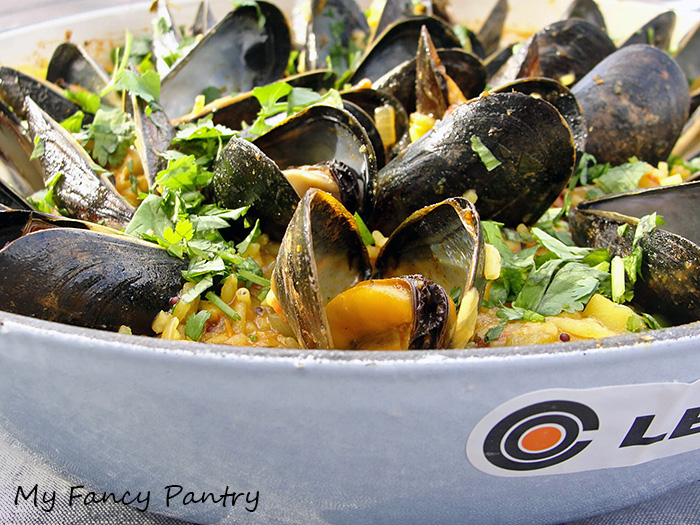
Indian Inspired Mussel Pilaf

Now, before I post this recipe, I have to say that it is not an authentic Indian preparation.  It’s just inspired by my love of spice. 🙂

Serves 4

Ingredients:

  • 1 lb. mussels– washed and de-bearded (see notes above)
  • 2 tbsp. oil (I used a mix of olive oil/ghee)
  • 1 large white onion- diced
  • 5 garlic cloves- crushed and minced (add less if you don’t like garlic a lot)
  • 1″ piece of fresh ginger- peeled, smashed and minced
  • 1 tsp. black mustard seeds
  • 4 thai chilies- slit (you may remove the membrane/seeds if you don’t like heat)
  • 1 large green bell pepper- diced
  • 2 medium potatoes- diced
  • 2 carrots- diced
  • 1/2 tsp. ground turmeric
  • 1 1/2 tsp. garam masala
  • 1 tsp. coriander powder
  • 1 tsp. cumin powder
  • 1 bay leaf
  • 1″ small piece of cinnamon
  • 4 green cardamom pods- slightly crushed
  • 3 whole cloves
  • 2/3 c. dry white wine*
  • 14.5 oz. peeled roma tomatoes- diced (equivalent to 1 can store bought tomatoes)
  • 1 c. frozen peas
  • water- 1 c. to start
  • pinch of saffron
  • 1 c. basmati rice- rinsed
  • salt- to taste
  • pepper- to taste
  • fresh coriander (cilantro)- 2 handfuls, chopped (one for recipe, one for garnish)

*If you do not wish to use wine, you can use water.  No problem.

Directions:

  • Heat oil in a large pot over medium-high heat.  Add black mustard seeds.  Once they start to sizzle, toss in the diced onion, green bell pepper, carrot, chili peppers and potatoes.  Lower heat to medium, and sweat the vegetables until they become soft and tender.
  • Add ginger and garlic. Also add the turmeric, garam masala, coriander powder, cumin powder, bay leaf, cinnamon, cardamom, cloves and 1 handful chopped coriander.  Cook for one to two minutes or until the raw smell disappears. Things should start sticking to the bottom of the pan, and you’ll notice things will turn a little brown.
  • De-glaze the pan with 2/3 cup of wine.  Stir everything really well and let this simmer for a few minutes or until the wine doesn’t smell so strong.  Add the tomatoes and cover the pan.  Let this cook for about 10 minutes, or until the tomatoes break down.
  • Add 1 c. water and a pinch of saffron.  Cover and let this simmer another 3-5 minutes.
  • Add the uncooked mussels to the tomato mixture and put the lid back on the pot.  Let the mussels steam for 5 minutes, then remove the lid.  Using a tongs, remove any mussels that have opened their shells and set them aside.  If there are any unopened mussels, place the lid back on the pot and let them steam an additional 2 minutes.  If they still do not open, they are most likely bad.  Toss them out.
  • Add 1 c. frozen peas.
  • Season with salt and pepper.
  • Add 1 c. raw basmati rice and an additional cup of water.  Cover the pot and let the rice cook.  After 10 minutes, check your rice.  Add more water, if needed.  The rice will take anywhere from 10-20 minutes to fully cook.
  • Once the rice is properly cooked, check the seasoning and add salt and pepper if needed.
  • Place the cooked mussels back into the pot of rice, place the lid back on the pot and turn off the heat.  Let the dish sit, covered for at least 3 to 4 minutes so the mussels re-heat.
  • Garnish with additional chopped coriander…and enjoy!

**NOTE**  I leave the whole spices in my dish, but if you would like you can remove them.  This can be difficult, but if you put all the whole spices in a little bag of cheesecloth before adding them to the pot it will make this task a lot easier.

I’ll get the printer-friendly recipe posted soon!

The only bad thing about this meal?

The lingering smell of the mussels.  Now my house is going to smell fishy for about a week.  Yuck.
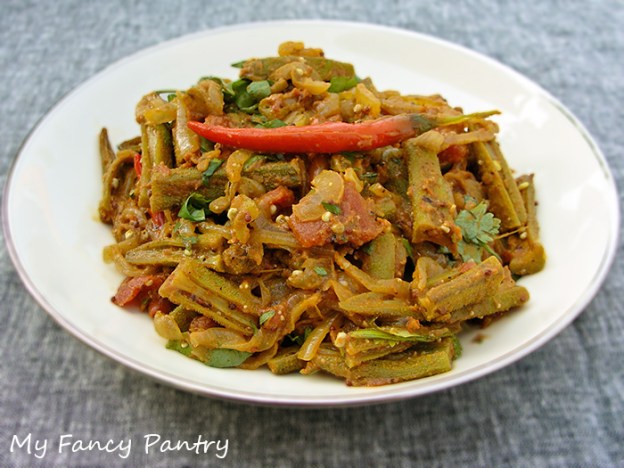
Bhindi Masala (Okra/Ladies Finger Dry Curry)

Bhindi, commonly known as okra in the United States, is one vegetable I’ve had little– to no– experience with.  It’s not that I didn’t like it, or that I felt intimidated by it’s funny shape and sticky, weird texture.  In fact, I didn’t even know it had a sticky, weird texture until fairly recently.

Instead, the simple truth is that okra is not a popular vegetable in Minnesota.  Most grocery stores don’t carry it, and most people wouldn’t know what it was or what to do with it even if they did.

Before Piyush and I were married, I wanted to impress him and make his favorite dish.  I asked him what it was and he told me “Bhindi Masala.”  I was absolutely confused.

I thought bindi was the forehead decoration (usually a red dot or jewel) worn by women…I didn’t realize it was also a vegetable! I must have had some sort of befuddled look on my face because Piyush then went into a 15 minute lecture about the Hindi alphabet and its correct pronunciation.

I learned that bhindi and bindi are not the same thing, but they sound exactly the same.  Exactly. Piyush assured me that they don’t, but I know what I hear; and to me there is no difference.

He then went on about bhindi, trying to explain to me what it was in English.  He kept saying “ladies finger” …I was even more confused. I thought ladies fingers were oval shaped cookies!  Then he said, “okra.”  I still had no idea what he was talking about.

Oh how times have changed…

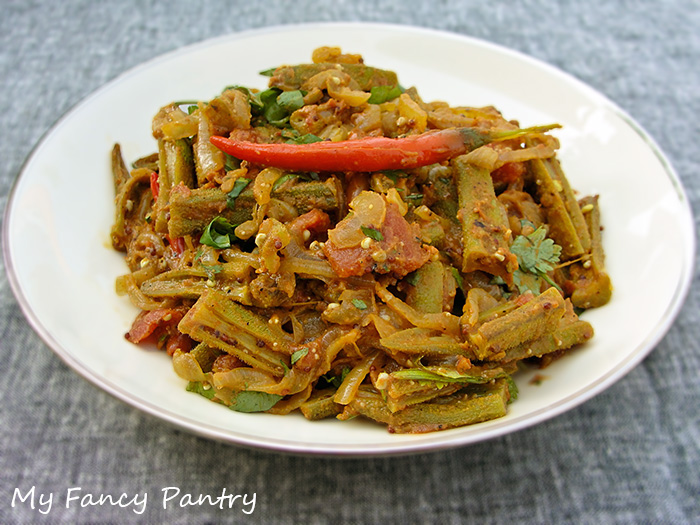
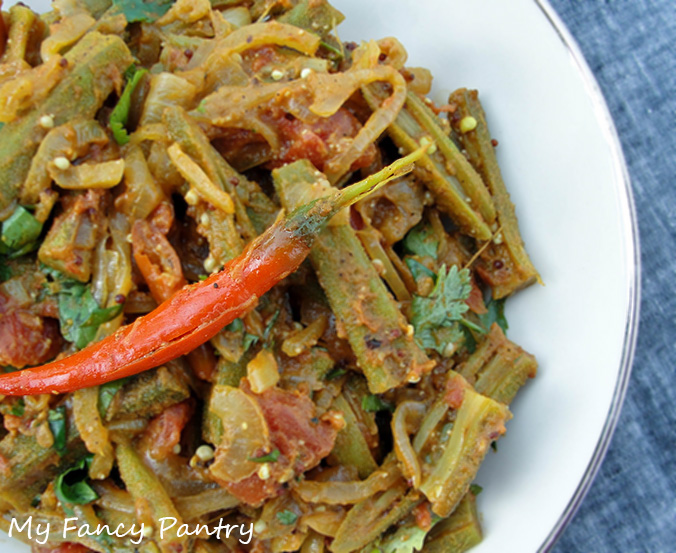
bhindi masala

I can’t say that okra is my favorite vegetable, but I’ve grown to tolerate it.  Piyush, on the other hand, could eat a whole pound in one sitting.  He loves the stuff!

Fresh okra should be firm, crisp and bright green.  They should also curve very slightly towards the narrow end.  Piyush says the best okra should be pretty small to medium sized.  The bigger the pods, the more bitter they taste…I guess.

I’ve learned that I can purchase fresh okra from any local Asian market.  Occasionally one of the sellers at the local farmers market will have a small container full as well.  I’m still not the greatest at picking the best pods, so when all else fails, the Indian market will have frozen okra.

Before you begin to cook the okra, there are a few things you should know.  First, it’s important to wash and dry off the pods, and to trim the ends.   Second, there will be a sticky, gel-like substance inside the okra.  It’s weird and slightly intimidating, but it will disappear  as the okra cooks.

For this recipe, I sliced the okra pods in half, and then cut them into manageable pieces–about 1 inch long, or so.  If you prefer, you could slice the okra into 1/2 inch circles instead.

The cooking process: 

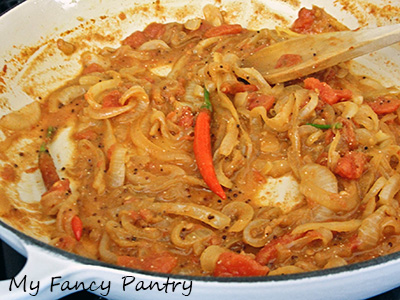
Onions and chilies are cooked until softened, tomatoes are added.

After the onions/garlic mixture has cooked…the okra simmers in a mixture of tomatoes and water

I’ve found that by adding the extra water to the masala, the okra is sure to cook properly and there will not be any stickiness left behind.  Simply cook the masala until the water evaporates and the bhindi is softened.  The resulting curry is considered dry, and is perfect for eating with naan, rotis or chapatis!

Bhindi Masala

Bhindi Masala 

Serves 2 as main course, 4 if served on the side

Ingredients:

  • 1 lb. bhindi (okra)
  • 2 tbsp. oil
  • 1 medium red onion, thinly sliced
  • 4 green chilies (I used Thai), slit
  • 1 tsp. khus khus (white poppy seeds)
  • 1 tsp. black mustard seeds
  • 1 tsp. cumin, ground
  • 1 tsp. coriander, ground
  • 2 tsp. garam masala
  • 1 tsp. turmeric, ground
  • 5 medium garlic cloves, minced
  • 3/4 c. fresh diced roma tomatoes (you may substitute canned or even use my curry base recipe)
  • 1/2 c. water –more if needed to cook the okra through
  • salt, to taste
  • black pepper, to taste
  • fresh corriander (cilantro), for garnish

Directions:

  • Wash, dry and slice bhindi as desired.  Set aside.
  • Add oil to a pan over medium-high heat.  Toss mustard seeds into oil and cook until they start to splatter.  Once the seeds splatter, add the cumin, corriander, garam masala, tumeric, chiles and sliced onions.  Cook for about 4 minutes, or until onions are translucent.  Add garlic and khus khus.  Cook an additional minute, or so.
  • Add the tomatoes to the curry.  Mix everything well and cook for two minutes before adding the bhindi.  Add 1/2 c. water, or more and allow the bhindi to simmer.  Keep adding water, as needed, if the bhindi is still giving off a sticky substance.  Cook for approximately 15-20 minutes.
  • Season with salt and black pepper, to taste.
  • Turn off heat and garnish with chopped corriander.  Serve with rotis…and enjoy!


Time to get ready for work!  Have a happy Friday, everyone! 🙂


Indian Spiced Hummus

I’ve never really been a huge fan of hummus.  In fact, I’ve bought it multiple times throughout the years, tried a tiny bit, and tossed the whole container in the garbage.  I wanted to like it, but I didn’t.   It just wasn’t my thing.

But, now it is!  

Once I made the commitment to myself to eat less meat (I still indulge once in awhile), I discovered just how good hummus could be.  It all started when I ordered a vegetarian pita wrap at our local Greek restaurant.

It looked like it was just a Greek salad stuffed in a pita; but once I bit into it, I tasted something smooth, nutty, and spectacular!

There was a giant glob of homemade hummus under that salad, and it tasted nothing like any hummus I’ve ever bought at the grocery store!  I was hooked.

I figured the only way I was going to get hummus that tasted like that was to make it myself.

I dug through all of my cookbooks, and finally found inspiration in “The Best Ever Vegetarian Cookbook” by Linda Fraser.  She had a recipe for Pan Fried Zucchini and Hummus.  It looked like such a weird combination, but it sounded amazing!

My version of zucchini with hummus

I didn’t follow her recipes at all.  I knew I wanted to make an Indian spiced hummus and zucchini with ghee, turmeric and cumin.  I read which ingredients she used to make hummus, and I got to work experimenting.

Hummus, in it’s most basic form, is simply made with garbanzo beans (chickpeas), tahini (sesame seed paste), lemon juice and olive oil.    Simple!

Because I wanted mine to be a little more than basic, I dry roasted a bunch of Indian spices in a pan and added in a little garlic towards the end of the roasting process (I think it makes the garlic taste a little more complex than just tossing in raw garlic).

I tossed the spices, along with the chickpeas, into the bowl of my food processor and blended everything until it was a smooth consistency.

I added the tahini, lemon juice and a little water to the mixture, and let it process again.  I tasted it; and added salt, black pepper and a little more lemon juice.  I tossed in some chopped coriander (cilantro).

I started the food processor back up (on low) and drizzled a little olive oil into the hummus–until it reached a perfectly smooth consistency.

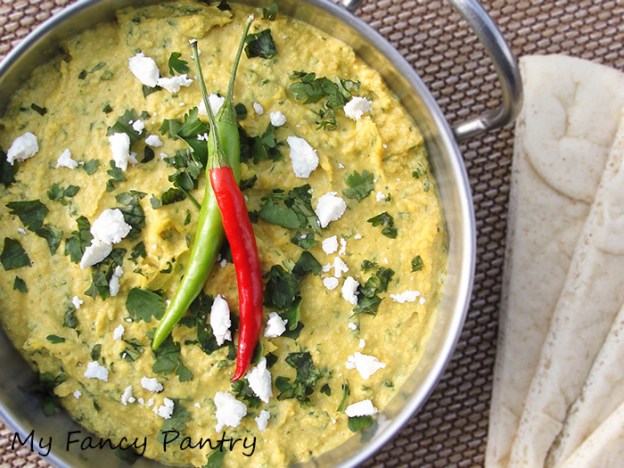
Easy Spiced Hummus

For those that are interested, hummus has around 100 calories for a 2 tbsp. serving.

I garnished my hummus with some chopped cilantro, sliced red chilies (for Piyush) and a little bit of feta cheese.

I served it along with wedges of pita bread and zucchini.

Zucchini cooked in ghee, turmeric and cumin

The zucchini was really simple to prepare.  I put a little ghee (if you’re vegan, skip the ghee and increase the olive oil) mixed with a small amount of olive oil into a heavy-bottomed pan. I turned the flame to medium and tossed in a good teaspoon of cumin seeds.

Once the cumin began to pop and sizzle I added 1/2 tsp. ground turmeric and 1 tsp. ground cumin.  I also added a few curry leaves (these can be omitted).

Once the spices no longer smelled raw (this is especially important for turmeric, in my personal opinion), I added about 3 (maybe 4) cups of diced zucchini to the pot, along with a little water (maybe a couple tablespoons).

I let this cook, uncovered, on medium heat for about 15 minutes.  I then seasoned with a little salt and pepper.

Cooking zucchini this way is so easy, and so flavorful!  Because it’s now zucchini season here, in Minnesota, Piyush and I eat this quite a lot!  In fact, Piyush loves it mixed with a little potato and served over some basmati rice.

Sometimes, I’ll even cook some dal (lentils) with the rice, and serve a sort of “dried” khichadi (the ULTIMATE Indian comfort food).

My delicious dinner. Doesn’t look like a lot, but it was incredibly filling!

Spice Spotlight: Cumin (Jeera)

I use a lot of spices here on My Fancy Pantry, so I reckon it’s about time I talk a little about them.  I decided to feature different spices in a new series called “Spice Spotlight.”  I hope you enjoy!


Today, I want to introduce you to cumin!

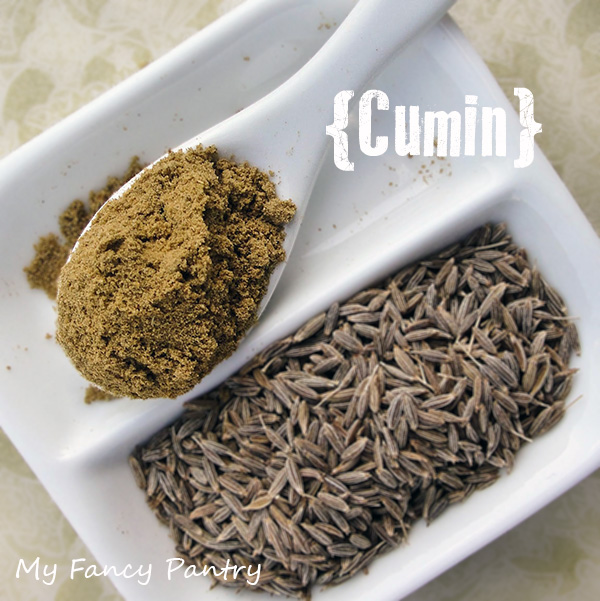
You see those tiny little seeds?  They don’t really look all that special; In fact, they look a lot like caraway seeds.

But trust me.  These little cumin seeds (known as Jeera in India) are quite extraordinary!

Flavor and Benefits:

The flavor that cumin seeds add to a dish is so unique, I’d even go so far as to say that it’s irreplaceable!

Cumin has a slightly nutty flavor with a mild citrus undertone.  It can also be described as somewhat “spicy” or “peppery,” which makes it fantastic for adding to curries, fajitas, soups and stews.  Cumin’s peppery taste is due to a certain chemical it contains which is similar to capsaicin–the active component in chili peppers.

Interesting.  I guess that explains why my mom thinks everything I make is spicy–even when I add no chili.   I thought it was all in her head…

Although cumin is primarily used as a flavor enhancer, it also has some added health benefits.  Cumin is an excellent source of iron, offers relief from acidity, and is even thought to aid in digestion.

Usage:

Cumin is used both as whole seeds and as a ground powder.

Sometimes a recipe might even call for cumin seeds to be added first, and cumin powder to be added later; so I always have both forms on hand.

It is a popular ingredient in Indian, Mexican, Latin-American and Middle Eastern cuisine, and is often used to flavor meat or bean dishes (I’m guessing this has something to do with it’s digestive properties?!…).

To get the most flavor out of your cumin seeds, I always recommend giving them a quick toast in a dry skillet; or letting them cook in oil before the dish is finished.  Not only will this help prevent tummy-aches, but both the aroma and the flavor will also be drawn out of the spice–making your food taste better!

How to toast cumin seeds:

  • Place the raw seeds in an ungreased skillet (I prefer cast iron).  Turn the flame to medium-high and heat until the seeds become fragrant and start to change their color.
  • Keep moving the seeds around, so they toast evenly.
  • Remove from heat at this point, and use in your recipe (or store in a jar).

Purchasing and Storing:

I purchase my cumin seeds whole from a local Indian market.  They’re sold in different sized bags and they’re quite inexpensive.  

If there isn’t an Indian market or other ethnic market nearby, purchase them online or at a c0-op.  You’ll get a much better deal (and probably fresher spices) than buying from your local supermarket.  

Once I get the seeds home, I put some of the whole cumin seeds into a glass mason jar and store them in the cupboard, as is.  They can last a long time there–indefinitely, maybe?

I also take about 1/2 cup of the seeds and toast them in a dry pan (see directions above).  Once they’re warm, lightly browned and incredibly fragrant, I place them in a coffee grinder–which is never used for coffee–and grind them to a fine powder.

Once the seeds are ground, I put the powder into a glass mason jar and it joins my other spices in the cupboard.

Freshly ground cumin will retain it’s flavor for at least 6 months–but if you’re anything like me, it’ll never last that long!


I hope you all learned a little something about this fabulous spice!  I’m definitely not an expert, so if you notice I got anything wrong, please let me know.

I’d also love to hear how you use cumin in your home?  What is your favorite dish using this spice?  

Meatless Monday: Indian Chole Masala (Chickpea Curry)

Happy “Meatless Monday!”

Indian Chole Masala

Chickpeas are one of my favorite ingredients.  There are so many things you can do with this humble (and cheap!) ingredient, that I always have a stash on hand.

As I’m still not feeling all that well, I’m going to keep this post short. Continue reading

Gulab Jamuns and Kala Jamuns: Indian Sweet Success!

Whoa! I haven’t blogged for over a week! I had quite a few posts started, but I just couldn’t find the motivation (or the time!) to complete them.

But really, if I’m being honest, it’s probably mostly because I just wanted a break from the computer…and the kitchen.

Indian Sweet Kala Jumun

If you’re a regular reader of my blog, then you may remember my first attempt to make gulab jamuns.  If you’re new to my blog, Namaste and thank you for visiting! You can read all about this tasty little sweet HERE.

Although gulab jamuns are quite tasty, kala jamuns are definitely far superior in taste (in my not-so humble opinion).  Kala jumuns are simply blackened gulab jamuns.  A scant teaspoon (more or less, depending on your recipe) of sugar is added to the dough.

When the dough balls are fried, the sugar begins to caramelize, creating a dark colored shell.

Frying the dough balls

After a few minutes…

Kala Jamuns: Black Gulab Jamuns

I’m not really that good at frying things–remember when I melted the plastic spoon (what was I thinking?!) trying to deep fry samosas?–so some lessons I’ve learned when deep/shallow frying are:

  1.  Do not use plastic utensils.  This should be pretty self explanatory, but apparently it isn’t.  Either that, or I have no common sense.
  2. Don’t keep the heat turned to HIGH, you’ll end up burning your food–and yourself.
  3. Don’t put too many things in the oil at once.  The temperature will lower significantly and the food might be oily/mushy.
  4. Don’t use the wok.  I’m not sure why this didn’t work for me, because it seems like it’d be a great pan to fry stuff in.  But my oil got way too hot, way too fast…and wouldn’t cool down.  My food was burned on the outside and raw on the inside.  Maybe there’s some frying-with-a-wok secret that I’m not aware of?  Care to enlighten me?
  5. While frying stuff–especially things that cook relatively quickly–you’ve got to pay attention.  This isn’t the time to organize your spice cabinet, or unload the dishwasher.  Trust me.

Aside from frying the dough-balls, they also have to be rolled properly.  If your dough balls have cracks all over them, they will probably break apart in the oil.

They might also become hard in the centers…and no one enjoys hard gulab jamuns!  There are a few simple ways to avoid the cracking of your gulab jamun dough.

First, you’ll want to be sure the dough isn’t too dry.  You might need to add a little additional liquid–only a tiny bit at a time.  The ideal gulab jamun dough should be pretty soft, and not crumbly.  It also shouldn’t be sticky or overly wet.  You’re aiming to find a happy balance between wet and dry ingredients.

If your dough seems fine, then maybe you need to re-think your rolling technique.  What i do is pinch a piece of dough and roll a ball between my two hands.  The ball will usually have a few cracks.  Then, I simply flatten it in my hands and re-roll the ball.

The photo on the top is what my dough looked like after I just rolled it into a ball with my hands.  This is what that same piece of dough looked like after I flattened it and re-rolled it:

You can see it’s a pretty huge difference!

Now, since we’ve talked a little about technique, let’s get to the recipe!  This recipe is quite good–perfect, even.  It took quite a few trials, and a lot of failures;

FAIL! The dough was too wet and I used too much baking soda. The dough looked perfect, but as soon as it hit the oil it swelled huge…and then collapsed.  The oil also was not hot enough.

but I’ve finally figured out how to make this extremely popular Indian sweet at home!

After my first trial, I got quite a bit of feedback from blog readers (thank you!) and my in-laws.  In fact, Maa (my mother-in-law) was so determined to help me, she attempted to make a batch so she could give me some pointers (and a great recipe!).

Maa’s looked so pretty, so perfect;

Maa’s beautiful gulab jamuns

but sadly we don’t get fresh khoya (thickened milk “dough”) here in America.  And I definitely didn’t have time to sit over a stove and stir all day.  So I did a little searching and found a bunch of things I could use in replacement of the fresh khoya.

Luckily, I was able to find something called “mawa milk powder” at my local Indian market.  Mawa powder is probably the next best thing to actual fresh khoya.  It’s similar to milk powder–but it’s thicker.  It is basically a dried version of khoya (you can learn about the differences between regular milk powder and mawa powder HERE, if you’re interested).

So now that I had the mawa powder, I had to figure out how to turn it into khoya.  I did a lot of research online, and couldn’t really find a definite answer.  I found one recipe that said to use 2 cups mawa powder and 1 cup of liquid.  So I tried it.  I kept adding milk/mawa until I got the amount of khoya Maa told me I’d need.

The dough looked promising, but it just didn’t work.  The gulab jamuns fell apart in the oil and became quite flat.  After a lot of experimenting, I finally stumbled across the magic and mysterious ratio of mawa powder to liquid!

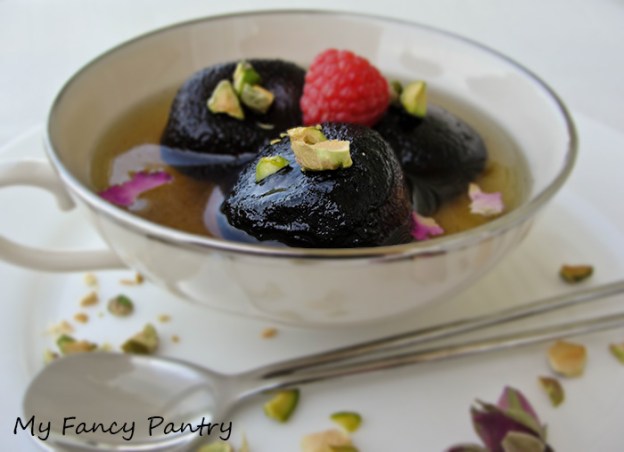
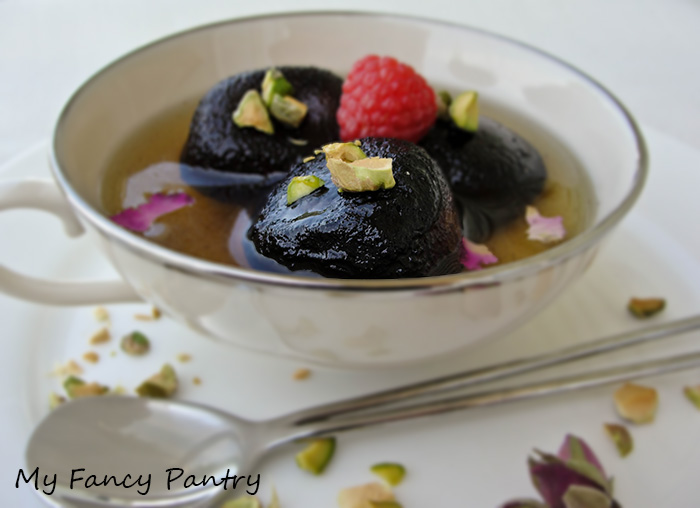
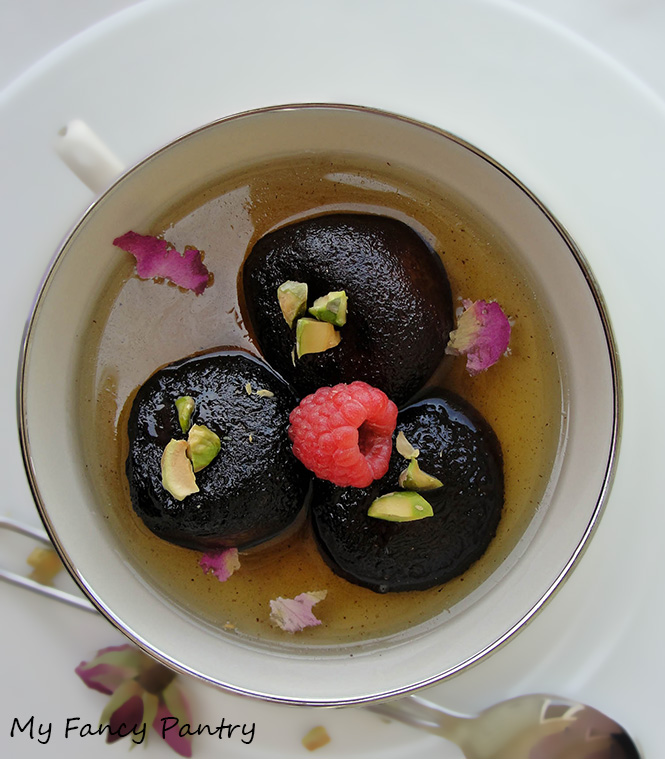
Kala Jamuns with a candied raspberry, pistachios and rose petals

The sugar syrup is quite easy.  Just toss 3 cups of sugar along with about 2 1/2 cups of water in a heavy bottomed pan over medium-high heat.  I added a few spices–cardamom and rosewater (I never really measure)–and let it cook for a good 20 minutes, until it thickened and became quite sticky.

When it’s the right consistency, remove from heat and cover with a lid to keep warm.

You can add cardamom, clove, cinnamon, maple syrup, lavender, rose water…the options are endless!  Just be sure to taste and add a little at a time so that the spices don’t become overwhelming  (especially important with cinnamon and rosewater!).

This makes quite a lot of syrup, more than you’ll ever eat with the gulab jamuns.  When the sweets are gone, I strain the syrup into a bottle and toss it in the fridge, labeled as “Gulab Jamun Syrup”.  It’s perfect on pancakes, in coffee, or to use in baking!

Gulab Jamun (Kala Jamun) Recipe:

Makes approximately 15 gulab jamuns–depending what size you make the dough balls

Ingredients:

  • 1 c. Mawa powder (available at Indian grocery stores, or online)
  • 1 tbsp. all purpose flour
  • 2 small pinches baking soda (approximately 1/8 tsp.)
  • 4 to 6 tbsp. half & half (start with 4, add more if needed)
  • spices- as desired (cardamom, clove, cinnamon…ect. Add whatever you like, just be sure not to add too much)
  • 1 tsp. sugar (only if making kala jamuns, leave out if making gulab jamuns).

Directions:

  • Heat a mixture of oil and ghee (I add about a tbsp. of ghee to whatever the amount of oil) in a heavy bottomed pan (I used a non-stick fry-pan).  You don’t need a ton of oil, maybe anywhere from 1/2 c. to 1 c. (this can be re-used a couple times).   Heat to approximately 300 degrees F.
  • While the oil is coming to temperature, toss all ingredients into a bowl and mix well.  Knead the mixture for a few minutes until it becomes smooth and soft.  Add additional liquid, as needed.
  • Roll the dough into crack-free balls, about the size of a large marble.  They will expand while cooking.
  • Once the oil comes to temperature, fry the dough balls in batches–about 4 at a time–until the outsides become brown or black (for kala jamuns) and the interior is cooked.  This should take about 4 minutes.  Be sure to flip the balls around so that all parts have equal color.
  • Remove from the oil and place on a paper towel for 30 seconds to a minute.  Toss into the syrup.
  • Let the gulab jamuns sit in the syrup for at least 20 minutes to an hour before serving–for best flavor!

Kala jamuns, unlike gulab jamuns, are not traditionally served in a bowl of sugar syrup.  Instead, they are usually left to soak the syrup, and then served “dry.”  But I say, do what you want! 🙂  Rules are made to be broken!

This recipe is absolutely perfect, and I think it’s the closest I could possibly get to recreating what I tasted in India!  Especially for the kala jamuns.  The outsides were sweet, black and oh so tasty!  The insides were moist and soft–not at all dry!

Piyush and I enjoyed these outside with a steaming glass of chai.  Indian sweets pair excellently with chai!

We also shared most of the sweets with friends and family (after all, I made about 5 batches…I was determined to make them perfect!), but they can also be frozen along with some syrup.

If you freeze them, pop them in the microwave for a minute–or so–to warm them up!

Chicken Chapli Kabab: Pakistani Style

We, Americans, eat a lot of burgers.  Hamburgers, turkey burgers, veggie burgers…they’re all an important part of our culture.   We love pretty much anything if it’s formed into a patty, placed on a bun, and slathered with toppings.  …and who can blame us?  Burgers are good!

We also love kababs.  Meat, veggies, fruit–it doesn’t matter.  If it’s been skewered or is served on a stick, we’ll eat it, and we’ll savor every last bite.

Now, things are really going to get interesting.  I’d like to introduce you all to the spicy, tender chapli kabab!

Chicken Chapli Kabab

It’s a kabab, but it’s not served on a stick.  It’s also a burger, yet it’s not on a bun.

The first time I tried traditional kababs, I’ve got to admit, I was confused.  They weren’t hunks of meat or vegetables threaded onto a skewer.  Heck, they weren’t even grilled!  Instead they were made of ground meat, studded with spices and little bits of vegetables.  They were tender, juicy, and quite unlike anything I’d had before.  I was hooked.

This version of kabab, the chapli kabab, is very popular in both Pakistan and Afghanistan.  They’re usually made with minced beef or lamb, but can also be made with chicken. The kababs get their name because of the way they’re shaped.  Piyush tried to convince me that they were called chapli kababs because they were flat like chappals (sandals), which is sort of true.

A pair of Piyush’s chappals

In actuality, they’re not named after the chappals, although it was a good guess.  They’re actually called chapli kababs simply because they’re flat.  The word chapli is derived from a Pashto (spoken in Pakistan and Afghanistan) word, chaprikh, also meaning flat.

Piyush and I first tasted the incredible chapli kababs at a Pakistani restaurant here, in Rochester.  The restaurant is called Kababs (if anyone is interested), and serves fabulous home-style food.  The food is very, very similar to authentic Indian dishes–especially dishes served in West Bengal (although the spices are a little milder, and the curries are definitely not as hot).  It’s cheap, and it’s good.

My chapli kababs were an even match, taste-wise, to what we ate at the restaurant.  The only difference is that I made mine a little thicker than they should be.

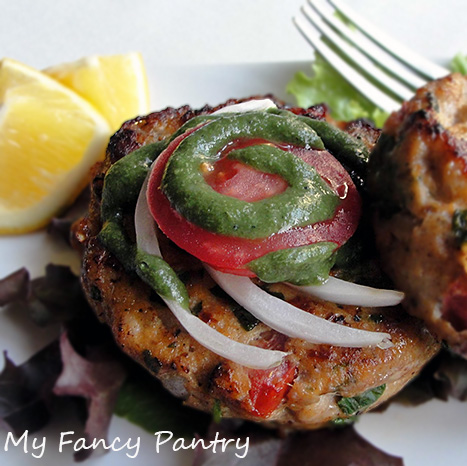
Pakistani-style Chapli Kabab topped with raw onion, tomato slice and mint/corriander chutney

I plan on making these again and again.  I can’t wait to grill these and serve them as alternatives to hamburgers at our next bbq.  Not only do they pack some incredible flavor, but they’re also pretty healthy.  Each kabab is around 140 calories, and it’s full of veggies.

I made the kababs using a pound of skinless, boneless chicken thighs.  I tossed the meat in my food processor and processed it until it was a smooth, paste-like consistency.  I then chopped a whole bunch of veggies: tomatoes, onion, green onion, serrano chilies, garlic, ginger, corriander…and tossed them all in with the meat.

I mixed everything really well, making sure to squeeze the juices from the tomatoes as I mixed–this helped keep the meat juicy and flavorful (I think…).  I added freshly ground corriander seeds (not ground to a powder), ground cumin seeds, dried pomegranate seeds, a little besan flour (chickpea) and even some crushed red pepper.  I seasoned the meat with salt and black pepper, and then formed into patties.

I used a pastry cutter to make the patties, mostly because I wanted them to be the same shape and size.  Also because I didn’t want to get my hands dirty after I had just washed them.  …What kind of cook am I?!

After the patties were formed, I tossed them in the freezer for about 15 minutes.  You don’t have to do this, I just find it helps hold the patties together a little better.  In fact, it seemed to work so well, I didn’t have a single patty fall apart on me.  Surprising, considering how much other stuff I had tossed in with the meat.

When I was ready to cook the patties, I put a little oil in a non-stick pan–just enough to coat the bottom.

If you’re trying to avoid oil, you could just use a non-stick cooking spray.  It should do a similar job, although you might not get that beautiful golden sear on the patties.

Chapli Kababs, ready to serve!

These patties were so juicy!  Chicken tends to get really dry, really fast; but I really think all the water from the veggies helped keep everything tender and moist.  This photo isn’t the best shot, but I think you can really see how juicy the kabab is.

Chicken Chapli Kababs (Pakistani Style)

Makes 9 medium-sized patties

Ingredients:
  • 1 lb. skinless and boneless chicken thighs (alternatively, you can use a combo of thigh/breast meat)- minced or ground in food processor
  • 1/2 medium white onion- diced
  • 2 roma tomatoes- diced
  • 2 large green onions- chopped
  • 3 serrano chilies (may use jalapenos)- seeded and chopped
  • handful corriander leaves (cilantro)- chopped
  • 1 tbsp. garlic paste
  • 1 tbsp. ginger paste
  • 1 tsp. corriander seeds – ground, but not into a powder*
  • 1 tsp. cumin seeds- ground, but not into a powder*
  • 1 dried red chile- ground to a powder (optional.  This will make the patties very spicy)*
  • 1 tsp. dried pomegranate seeds- ground*
  • 2 tsp. besan flour (chickpea flour–alternatively all-purpose flour would work too)- more if needed to hold the patties together
  • salt- to taste
  • pepper-to taste
  • oil- for frying (I think I used about 4 tbsp. total)
* Note: Any ingredient with a * after it could be substituted by using a pre-made chapli masala mix.  This mix may be hard to find, but many Pakistani grocers (and even some Indian grocers) will carry it.
Directions:
  • If your meat is not minced, grind it in a food processor until it is broken down and is paste-like in consistency.
  • Add all chopped veggies and spices to the meat, and mix together using your hands.  Squeeze the tomatoes as you mix everything together, releasing their juices.  Mix until everything is well combined.
  • Form the meat mixture into patties.  Either roll the meat into balls and flatten with your hands or use a burger press/mold.
  • Freeze patties on parchment paper for about 15 minutes.  They don’t need to be frozen through, just cold enough that the meat sticks together better.
  • Heat oil in a large non-stick pan over medium-high heat.  Once the oil gets hot, add the patties.  Cook in batches so they are not over-crowded in the pan.
  • Cook each side for about 2 or 3 minutes, until you notice a nice golden color on the outside.  Watch the sides of the patties, once they are no longer pink or raw, your kabab should be nearly done cooking.  Total time, about 5 minutes a patty.
  • Remove cooked patties from pan and lay on a plate lined with paper towels.  Serve immediately, garnished with corriander leaves, tomatoes, raw onion, and lemon wedges.  Serve the kababs along with chutney and rice or naan.  Enjoy!

And now, because I shared Piyush’s pretty chappals, I wanted to share some of my own Indian-style footwear! …I mean, what girl doesn’t love shoes?!

These were bought in Kolkata.  I love them, but have not worn them yet.  I’m putting it off because I know it’ll be painful (at first…).

These are my favorite, and were purchased in Amritsar, India–near Pakistan.

Yes, I really am that white. It’s sad, really. I wish I could tan…  I also have hideous feet.  They’re ugly, but they’re mine. 🙂

These shoes aren’t called chappals.  I can’t remember what they are called, actually.  They took about a month to break in (after struggling though some bad shoe bite!  They even made my feet swell HUGE), but are now my most comfortable pair of shoes.

…and since I was mentioning Pakistan, I thought I’d share a photo from the India Pakistan boarder.  This is as close as I got…You see that big white structure in the back of the photo?  That’s the entry to Pakistan.

It was incredible to see all the patriotism–from both India and Pakistan.  There were tons and tons of people, lots of dancing and music, and even a peace ceremony between both countries.  It’s something I feel blessed to have attended, and I hope to attend again (although we’ll get there earlier next time.  It fills up fast, and can be really hard to see anything).

If you’d like to see the ceremony, here is a video that explains it pretty good:

http://www.youtube.com/watch?v=YeSX6AZ5xEI